Friday, January 27, 2012

Review of Jimmy Wales's Twitter

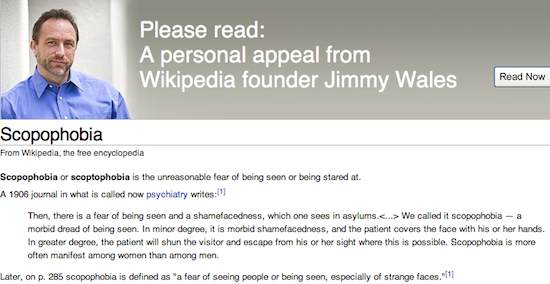
Jimmy Wales is a person who’s creation many depend on daily, but do not realize. For those who are not familiar, you may recognize him as this man in this banner. Wales is the founder of Wikipedia and has been prominently featured on his site for the past few months asking for donations. Wales also has a twitter account, which will be the subject of this post. Jimmy Wales’s account, appears to be a combination of personal tweets and tweets supporting his political beliefs in a ratio of about 1:1. For example, he has tweets about his delayed flight to Atlanta, but also has tweets concerning piracy, SOPA and PIPA, and the United States government. It can be assumed from his tweets that he is fairly liberal. Wales is one of the leaders against SOPA and it shows through a large fraction of his tweets against it, as well as the “With Your Help, We Can Defeat SOPA” statement in his “about me” section.

Wales’s twitter is interesting in that it is used for both for his personal life and business. Usually, business accounts, such as that of prominent scientist Richard Dawkins offer little original material, often linking to other sites. In comparison, personal accounts, such as that of Steven Colbert, offer original material, thoughts, and nonsensical tweets. Because Wales’s account does both, it is more personal that a business style account because it humanizes him, but also provides informative content. The personal nature of the account makes Jimmy more relatable, which could net him more flowers, helping to get his message out. In this sense, Wales’s twitter account is effective by attracting users to it.

However, the content of the posts seem to lack substance, although this is a fault of twitter’s character limitation more than that of the poster. I found the most informative posts to be those that link outward to other sites. Because the most interesting ideas are usually complex and nuanced, it can be difficult if not impossible to express them in 130 words or less. Although for entertainers such as Steven Colbert, 130 characters may be a perfect amount to deliver that punchline, it is not enough for complex arguments. In fact, the majority of his more serious posts, such as “5% think Congress doing a good job but re-election rates will remain high: evidence of a corrupt system?” are linked to full articles on other sites.

Wales attempts to bring up a number of political topics he finds important. The majority of them point to SOPA and the government’s unwavering support of it. He tweets updates on the results of his Wikipedia SOPA blackout, as well as commentary on American congressmen’s lack of support for their constituency. Although it is clear that Wales is against the current political system and against Internet censorship, it is not exactly evident why. Looking through his feed, he does not specifically mention why he is against the corrupt system or even why the system is corrupt. Again, I feel that this is not the fault of the author, but the nature of twitter. Attempting to convey these types of ideas would be confusing oversimplified and would not do the idea justice. Because of this, should serious discussion even be conducted on twitter? If this is the case, can any social media be used as a medium for serious discussion?

In Review of "Twitter Account of Jack Dorsey"

Jack Dorsey is a co founder of Twitter and an inventor. Jack is currently promoting his newest invention the Square which allows one to swipe credit cards using their mobile phone. Dorsey's Twitter posts are nothing too out of the ordinary, except for the fact that he seems to like to welcome people to Twitter and promote the Square. However, as with all Twitter feeds it is almost impossible to gain any other information out of it with knowledge of the context. Dorsey seems to use his Twitter everyday as would I if I created Twitter, at least until I found that I couldn't stand to write in extremely short increments. Dorsey's Twitter seems to not attempt to change or persuade the world but rather show that his Square is now sold @place and @here and to communicate with the ones who made him rich. Jack seems to keep a nice balance of personal and business tweets. This, I believe, keeps him likable allowing him to draw in more and more followers giving him a bigger group to advertise to when needed. Dorsey also does a good job with relating to his customers, he sends them pictures replies to their tweets, and tags them in his tweets. Twitter appears to be a very productive business tool for Jack

I can completely see why Jack would use a medium such as Twitter to advertise his products, I mean he did help create it, but it also helps to mention that Jack currently has 1'846'970 followers. This massive amount of people doesn't only see every post he writes everyday but they also think he's a genius for creating one of the most popular social networking sites we have today. Twitter's 140 character maximum is all Dorsey needs to get his message across, not to mention that he can casually post numerous times about his newest invention. Jack's likability and relation with the consumer plus the fact that he can communicate with an individual and promote his products to millions at the same time really helps his cause and is genius.

Jack's Twitter is a great tool for business assuming that his followers actually care about what he is talking about. Many of his followers may have had the intention of following him just because he's one of the guys who founded the site they use every day. Besides that though how many of his followers need or care about the Square? I'm sure only a small fraction pays attention to those tweets at all. Nevertheless his followers do see his tweets so at least he can get those people to think about his product for at least a split second. That way when they come across someone needing a product like the Square they can say, "hey I've heard about something that you can use for that" and he has one more customer. I must admit I had never heard of the square before reading his tweets and I have no use for one, but I know a few small business owners who this could be good for and will be sure to let them know about it.

Is Twitter a better medium for advertisement than television now? Do people actually pay attention to other peoples sales bids on Twitter?

In response to Al Gore's twitter account/blog site


For this blog assignment, I decided to take a look at Al Gore's twitter account. I'm not exactly sure why, but after doing some poking around I feel like Al Gore's account in particular just strengthens several of my current opinions.
First, I would like to state that I've always thought Twitter to be an insanely pointless site that does nothing more than accelerate the process of “dumbing down' the global population. When Twitter first broke into an unexplainable popularity among social network fanatics, it's first recognizable flaw was that one could only post very short “tweets” which are comparable to Facebook's “status'. In response to someone's tweet, one could only respond with another tweet, which leaves followers with nothing more than a thread of short idiotic statements with which to read. Not only do we have regular everyday people posting shallow statements about where they are and what they are doing on the internet, but now we have celebrities and other “significant” people tweeting. In this particular case, I was surprised to find that even the former Vice President Al Gore was spending his valuable time with something as pointless as twitter.
Al Gore, as expected, spends his days tweeting about the same out-of-context crap that everyone else does, but every so often I was able to make out what one of his tweets actually meant. Of those that I could decrypt, most were about environmental awareness. If you spend enough time actually putting the pieces together, I'm sure you could find that to be a common theme throughout his entire Twitter profile. Though, what I find makes this website at all useful is its advertising capabilities. Gore, after every one of his tweets, includes a link to his blog where he can actually tell you what he's trying to talk about.
So after shedding the waste of time that is Twitter, I was able to read some of Gore's intellectual thoughts in whole pieces on his blog site. It's not a highly decorated site, but for a picture of Gore sitting as his desk. This picture, combined with a section that allows users to “join the conversation”gives Gore's audience the impression that they are speaking to him directly, which they may or may not be doing. Also, on this site, Gore's blog section is labeled “Journal” again trying to validate everything written as his own original work, which again, it may or may not be. Avoiding that point, one can still clearly see that this site makes a significantly better attempt at advertising what Gore wants readers to hear. There is a section to purchase books and DVDs as well as a section that routes visitors to Gore-supported sites, such as TheClimate Reality Project and on occasion he throws in a link for political purposes.
Twitter is good for advertising to other Twitter users. One simply posts a link as a tweet and hopes that people follow it to a real site. As close to useless as Twitter actually is, what really grinds my gears is the fact that people will drop the words “hash tag” to me in real life in a real life conversation. Get a life outside of the world wide web losers. I apologize if I've offended anyone, I'm slightly passtionate about this particular topic. 

Friday, January 20, 2012

In Response to: "Apple iBooks 2 with Textbooks may reduce back pain and improve student health"

In the recent ZDNet Blog Post, “Apple iBooks 2 with Textbooks may reduce back pain and student health”, the author, Matthew Miller discusses potential benefits of Apple’s new iBooks program. This is a program/ecosystem just released by Apple on Thursday (January 19, 2012), where it now offers to sell textbooks through its already existing eBook store, iBooks. Following in the footsteps of its historically popular iTunes ecosystem, Apple is attempting to break into the bold, new (and lucrative) world of eBooks. In the article, the author discusses some of the advantages he believes the iBooks ecosystem will bring: less pain from carrying heavy books in backpacks and saving students money. He cites how his daughters in public school are forced to carry books in backpacks ranging from 10 to 30 pounds. With iBooks, he states this would no longer be an issue. Miller also recalls how he would spend $400 on textbooks in university and states that Apple’s iBooks would help lower those costs.

Being posted on ZDNet Blog’s The Mobile Gadgeteer, Miller appeals to a tech-saavy audience. The organization of the site follows a general Web 2.0 design, which would be appealing to those who are interested in technology. The blog itself directly appeals to those who are into the newest consumer electronics. By implying that a new component of consumer electronics is beneficial for one’s health, it draws in those they probably use these electronics on a daily basis. However, on first read, I thought the title would link or refer to a study that actually shows the statement to be true. Instead, it did nothing of the sort, being just pure speculation. In addition, when stating that iBooks would be able to save students money, he cites no prices or even speculates prices. While the article does a good job drawing readers in with its catchy title, it does little to back up its over the top claims.

The article, on top of its poorly substantiated claims, made a number of questionable assumptions about iBooks. For example, the claim that it would be more affordable appears to be unrealistic considering Apple’s precedent with music. When selling music on iTunes, Apple’s prices are not much cheaper than those of CDs or other sources of music. It would be reasonable to assume that this would be the same case with books. He also assumes college students would prefer an eBook textbook over an actual physical textbook. I may be old fashioned but when working on problems in a textbook, flipping back between problems and examples, an eBook is more cumbersome. In addition, the author promotes an eBook textbook future under the reign of Apple. Would this be the best considering Apple’s prolific past history of DRM? Under this, instructors would no longer be able to hand out class handouts or copies of textbooks and instead force students to buy entire textbooks even if they only needed to use a small section of it.

The article also shows the typical issues of mass media blogs. ZDNet shows the issues of many of the tech sites owned by the “Big Six” media corporations. ZDNet, owned by CBS Corporation is one of the “Big Six”. These companies, with a priority on profits over traditional reporting, often churn out articles such as the one mentioned, that emphasize hits (number of users clicking on the article) over quality material. The more hits, the more money from advertisers. This blog post is an exemplar of this type of reporting, with a catchy, misleading, unsubstantiated title, and text that is pure speculation, turning something insignificant into a news topic. Should we even trust these articles from these news/blog sources? Is there a way we can curb practices where profits rule even on the web? These are clear problems of the Internet that have yet to be addressed.

In Review of "Why PIPA and SOPA Is Good and Needed"

The blog post Why PIPA and SOPA Is Good and Needed is posted on the blog called Smart Helping. The blog is created by Jason Varner and in his description he says his goals are to help and, "enlighten" people. Justin's post tells why the internet needs these two bills to pass and why he can justify them. Justin's blog states that the massive websites that are protesting SOPA and PIPA are only out to ensure, "their own survival". Justin also believes that the bills will help people with their own personal websites.

The blogs main message is to show people that SOPA and PIPA are actually going to do them some good. Making the internet less cluttered, helping people create and maintain their own websites, and to make the large companies start thinking about the majority of the people are the arguments made for this message. With the internet less cluttered Justin believes that it will be easier for people to find and access more reliable sources. Justin also suggests that if the major companies are held in check by these bills then they won't be able to overshadow smaller and less competitive websites. Justin tries to persuade people by saying these bills will take down large companies and help the little guy succeed online. The thing is if the little guy makes one mistake he'll have the same fate as the corporations.

I personally do not believe anything this post says about SOPA and PIPA. The wordings of the two bills are very vague and basically say that any website using any copyrighted material can be yanked in the blink of an eye. This would spell the end for many of the useful websites I use today. Wikipedia, Google, YouTube, could all be banished from the face of the planet. If something like this were to actually be passed it would be devastating to the internet. SOPA and PIPA are intended to stop online piracy, but pirates will find a way around this almost indefinitely. Even the small websites that this blog says would be benefited by the bills could be stripped from the internet for something they may not even know was copyrighted. The large corporations that this site would destroy are some of the sites that help me most. Google and Wikipedia have helped me more times than I can remember and YouTube for just plain fun when I'm bored. The internet just wouldn't be the same if these bills are allowed to pass.

I don't think anything anyone could tell me truthfully about SOPA and PIPA could persuade me to change my mind at this point. The only thing that can change my mind now is if the bills do pass and the internet is actually improved somehow. In that case I will admit to being wrong and embrace SOPA and PIPA, but in reality I think very few people see that coming. Hopefully the US congress will see what a joke this bill is and toss it in the trash.

Sunday, January 15, 2012

Response to: “The Willpower Trick”


 This blog was released on Wired by Jonah Lehrer on January 9th 2012. Lehrer starts his blog by targeting a large demographic: those who have been unable to uphold New Year's resolutions. He determines that broken resolutions are the result of our feeble minds and willpower. One highlighted theory is that humans have a threshold of information that they can hold before their willpower begins to weaken. This theory is supported in an experiment by Baba Shiv, a behavioral economist at Stanford University. The experiment demonstrates possible negative dieting behavior based on outside stresses. Lehrer goes on to express that willpower is not based on moral fiber or the ability to resist temptation, but instead the ability to remove temptation from the equation. Those who are able to see the difference and and remove temptation are typically more successful in achieving their goals
Wired is a site that is meant to have both attractive content and cosmetics. Bloggers express their ideas in terms that lay people can all understand on topics that proves interesting to a broad audience. As I read more blogs on Wired, I have noticed that most of the content follows a general pattern: A colorful and attractive background and a picture that exaggerates an already misleading title. This blog in particular is titled “The Willpower Trick” when in reality there is no trick to increasing willpower, and the illustration symbolizes the concept of “Jedi mind tricks”.
As misleading as the title and illustrations may be, Lehrer is able to properly use his hook and keep the audience interested. Once the storm troopers catch the reader's eye, and the title suggests that Jedi secrets will be revealed, the attracted reader will stumble into a first paragraph that strays toward a more defined topic. However, instead of being a turn-off, simply speaking about New Year's resolutions and claiming to have the answers for successful dieting and weight loss pulls the reader in even further.

Friday, January 13, 2012

In Review of "New York City Health Department Launches Portion-size Campaign"

The blog, Food Science, is written by Marion Nestle, professor in the department of nutrients, food studies, and public health at New York University. Marion's blog is about food and the role of government with food. The post "New York City Health Department Launches Portion-size Campaign" is in reaction to New York City's Health Department starting a poster campaign throughout the city's subway system. The author seems to agree with the campaign as it she states that larger portions have more calories, induce people to eat more calories, and induce people into underestimating the amount of calories they are actually taking in.

Dr. Nestle's message seems to be that most American's cannot be trusted to watch their own diet and therefore it must be the responsibility of the marketplace to do it for them. It appears that Dr. Nestle may be striving for a more science savvy audience as the title and background are
non-enthusiastic. Looking deeper into the article, though, the simple layout including the bullet points, as well as the fact that the reader needs no prior knowledge of the subject makes the article appear to be for the casual reader. Dr. Nestle seems to write this blog at this time because it looks as if America's eating habits are worse now than they've ever been.

The blogs message of American's not being able to be trusted to control their own portion size can go one of two ways. Option one can be that the public mostly accepts this campaign and the marketplaces decreases their portion sizes. In this option the people don't have to be responsible for controlling their own portion sizes. This option gives the government more of a reach into our lives for better or for worse. Option two is that the people of New York react negatively to this campaign and it fails. If this is the case nothing changes. The better option of these two is definitely option one. Though the downside may be the government having a bigger impact in the lives of its people it is for the better. With this option maybe the increase of obesity in New York begins to slack off. The success of a campaign like this will, hopefully, bring a wave of change, and if not, well, at least one city can be considered a little bit healthier.

This article brings up many good questions about American society as a whole, though, it only talks about one city. The article brings up the point that in actuality the American public cannot control its appetite and therefore may have to have it controlled for them. The questions that come to mind are can the American public handle having their portions adjusted for them? How will adjusting portion sizes affect the fast food market and the still struggling economy? If given the power how far would the government go in controlling food portions? Would adjusting portions really help all that much? These are just a few of the questions that are raised from this blog and the answers could really help us to learn more about American society.

Thursday, January 12, 2012

In Response To: "We Still Haven't Explained Pink"

The ScienceBlogs hosted blog, Pharyngula, recently posted “We still haven’t explained pink.” The post, written by Dr. PZ Meyers, is a response to an article on Discovery news stating that women are genetically predisposed to prefer the color pink. The post author, refutes the statements of the Discovery news article, citing poor scientific rationale. Dr. Meyers breaks his argument into multiple parts. He states pink has always been associated with girls, so as a result, the distinction is assumed. However, he shows evidence the distinction has only been present for the baby boomer generation. Meyers then continues by refuting the theory from a paper stating that the preference for pink is evolutionary. The author then furthers his argument by citing and explaining another academic paper with the inclusion of graphs.

Dr. Meyer’s blog is clearly directed towards a scientifically educated audience. The plain graphics and poor Web 2.0 implementation clearly do not strive to attract the curious browsing visitor. The overall cluttered and relatively unattractive design of the blog makes it apparent the audience is attracted by content rather than visual appeal. The same conclusion can be drawn when looking at the title of the post, “We still haven’t explained pink”. The title does not exaggerate the content of the post and therefore has no pretensions to grab the reader in with a catchy (but misleading) title. Looking further at the post itself, Dr. Meyer writes with the assumption that the reader has an understanding of the theory of evolution and scientific arguments. From all of this, it can be assumed that the audience of this blog is well educated with a strong interest in the natural sciences.

Throughout the post, Dr. Meyers sharply criticizes the quality of reporting from a number of mainstream media sources such as Time magazine. He uses harsh language, citing a paper as “disappointing tripe” or referring to the Discovery news article as “the terrible evpsych rationale […] that just made no sense.” It is evident from his language that Meyers holds a disdain towards the relatively uninformed mass-market media. This addresses an important issue of science; its inaccurate portrayal by the mainstream media. It is an issue that is little addressed so it is commendable that Meyers writes about it. Poor science reporting results in a skewed view of the subject by the general public. This form of science reporting is based off the concept of headline grabbing rather than reporting the truth. Doing so is damaging towards the pursuit of science itself, almost belittiling the hard work of researchers. However, the condescending tone of the post and argument do little to help convince others of Dr. Meyers’s point. While regular readers of his blog most likely agree with his point and are aware of the media’s ineptitude, most others do not.

Regardless of his tone, Meyers brings up a number of important issues concerning science reporting. He brings up the point that the reporter of the original is “credulous” implying that he does not have any science training. In fact, the author of the article cited by the Discovery news article, Coco Masters, is not a trained scientist by any means, but rather a “media and communications specialist”. This begs the question of whether we should have scientifically trained journalists report about science and technology news. Would this help the quality of reporting? It would be reasonable to assume that this is not currently done because there is no awareness of how inaccurate and misrepresented science reporting is. If there is no demand for change, the media will not change their presentation of science reporting because the current system is profitable enough. This then raises the question of how awareness for this issue could be raised effectively to make change more favorable. Perhaps Dr. Meyers’s post is a good start, but the issue must be made more apparent to a broader audience.