Before this class I had blogged only a few times for English 110. It was very limited and was just a small response to articles I found interesting. Now, though, that I have seen and responded to numerous different blogs I feel that blogging offers much more than first expected. They allow others to spread their ideas and see what others think of those ideas. Blogging is a great tool for communicating and discovering the thoughts and feelings of those around the country or world. Albeit, many are just thoughts and feelings or opinions, very few blog posts provide real factual evidence. However, some blogs do not need or are not interested in providing factual evidence. Therefore, blogging is a great way to communicate and learn others ideas and can help keep a sense of togetherness in society today.
Blogging is great for getting across your message especially if the media lacks significant coverage on it. Allowing one to get their message to others and spreading the word can be a great thing for society. This can lead to an expanded knowledge of what is actually happening in our world, rather than just what the media wants us to see. The blog "Bad Science" covers the topic of the media using faulty science to be able to report what they want. This blog can be helpful to others because it attempts to expose the tactics used by the media to mislead them. The blog focuses mainly on medicine and how the media can use statistics in a very deceptive manor. This insight can help an audience be wary of the tricks the news media pulls on them. Blogs like this can be enormously helpful mostly because it is trustworthy due the fact that is one of the blogs supported by hard evidence.
Not all blogs are supported by evidence though. The blog "Food Gal" is one of those blogs that neither needs cold hard facts nor is it interested in facts. This blog is mainly about recipes, giving insight as to whether or not they are worth making. This blog is pure opinion, only backed by the author's personal experience. This is absolutely fine because the author's only goal is to provide people with her cooking opinion and hopefully keep people from wasting their time. Blogs like this can help society in a great way as well because it brings the sense of togetherness.
Blogs, not including those whose authors insist on ranting incessantly about their lives or other nonsense, can clearly be seen as a beneficial addition to society. Blogs can be a great source of academic learning or a way to express opinion, either way they provide some kind of knowledge to those who read them. Using blogs in the classroom are certainly a must. Blogs are so diverse and insightful that it would be foolish not to at least mention their importance. Blogging is a very easy way to help society stay informed and united.
Friday, March 2, 2012

Blogging as an educational tool
Blogs are an obvious part of modern culture. Though little a decade old, it has become part of the daily lexicon. Through their expression, they have become an example for both the creativity and diversity of the Internet. Their greatest strength is their freedom of expression on a broad breadth of topics. For the majority of blogs, authors get to write what they are truly passionate about, whether it be food, politics, or science. It is this passion for the respective topics of blog posts that makes them so unique. For example, “The Everywherist” is such a successful blog because the author of it is writing about something she is passionate about. Although it is a travel, blog, she writes about other things she enjoys such as inexplicable foreign TV shows and obnoxious airplane passangers. The freedom to write what she wants makes the blog successful because each post wants to be written. It is clear from the writing the author cares about the topic, making it appealing and interesting to read.
However, it is this freedom of expression and random thoughts that is also one of the limitations of blogs. Because of this, many of the best blogs lack the focus of traditional Internet sources such as newspapers. Their informal writing style can often seem unprofessional rather than just informal. An example of this is a I blog I analyzed recently in a previous post is the science based blog “Pharyngula”. Although the author often has excellent and well-researched reasons behind his points, he has a conversational tone that leans on the side of condescending. Because of this condescending tone and occasional divergences from the main topic, it is more difficult to take this blog post as a serious discussion of the topic. However, many of the blogs that often follow a more serious presentation of content like the Wired blogs lack the soul found in the best blogs.
In the context of the classroom, blogs can be an effective tool to teach writing if the assignments using the blog utilize the strengths of blogs, their freedom and diversity of topics. The blog assignments this quarter have been relatively lax in their requirements. However, during the entire process of writing each of these assignments, I never forgot the fact that I was writing for an assignment. At this very moment, I am thinking about how I can satisfy the requirements for this post. I believe that the writing for these assignments would be of a higher quality if the assignments gave more freedom on how they could structure the posts. By having strict guidelines on what should be in posts, the final product ends up feeling like a short essay. It would be necessary to have the blogs site proper sources just to keep the topics of discussion educated and relevant. Even with that stipulation, I believe that the posts could be of better quality because they allow the writing to take on the style of the writer. Often times, this is the very thing that gets muffled in academic writing, while blogs thrive on the writing style of the author.
The Final Blog
I personally believe that blogging is a really useful tool for sharing ideas and can also become a successful marketing tool if manipulated correctly. When I first started writing blogs for this class, I initially thought that they were a waste of time because my assumption was that blogging was essentially an extended tweet. I don't know anyone who cares enough to subscribe to my blog just to read about my daily life and activities. However, once being introduced to the world of, I guess you could call them, professional bloggers, I realized that its basically a way to throw your opinion out on the internet and otherwise inform or become informed by audience feedback, and as I said previously, it can be successful as a marketing tool.
The only problem I can see with blogging, despite all their advantages, is expanding your audience. Simply getting people to read your blogs seems like a daunting task but one way bloggers seem do this is by their manipulation of rhetorical devices. For instance, the first blog we read in class sought to inform readers about an advancement in technology that could potentially allow us to create invisible soldiers. Unfortunately, it turns out we are far from being able to practically use this technology, but the blogger was able to inform, entertain, and draw in an audience. All it takes is a bit of talent and one can obtain subscribers in this way.
Talent is essential when trying to use blogging as a marketing tool as well. Unfortunately his account was suspended for reasons unknown to me, but my roommate is an affiliate marketer. To increase the amount of hits he got on his links, he did a lot of research, started a blog and wrote about electronic cigarettes verses real tobacco on a weekly basis. Eventually, as he proved to be an "expert" in the field by answering questions and continuing to throw his opinion out there, subscribers became more inclined to purchase the products that he was selling. This is just one way to use blogging as a marketing tool, but it is a very effective weapon if wielded correctly.
It might seem like I have a new-found respect for blogging, but it turns out that I was actually a fan of a few blogs before I knew what blogs really were. For instance, there's a site I am really fond of that just includes a series of hilarious rants about relevant topics. The author, George Ouzounian (pen name: Maddox), in one particular blog shares his feelings about vegetarians, PETA, a potential asteroid collision, and his naysayers all in a simple three-minute video. While Maddox isn't someone you'd site as a scholarly source in an English 367.04 paper, he does present his ideas in an entertaining and convincing fashion. His notoriety even inspired a comic book, which was presented by him at comic con San Diego, and a book that reached #1 on the Amazon.com sales chart. The success of his first book propelled him on to a few television sets and inspired a second book that was published in 2011. In the case of Maddox, blogging contributed to his career in two ways: both as a marketing tool and a way to share information. He marketed his ideas and his personality which acted as a springboard for his career.
Based on my past experience in blogs, I can't say that they are an excellent source for hard facts or scholarly information, but what they can do is give the audience experience with different opinions and the angles. Being able to see how a blogger is trying to persuade and possibly manipulate their audience is a great tool for college students to learn. This knowledge enhances our abilities to sell ideas and question what others are selling us. It is needless to say, taking this class and working with blogs has changed my perspective on blogs in general.
The only problem I can see with blogging, despite all their advantages, is expanding your audience. Simply getting people to read your blogs seems like a daunting task but one way bloggers seem do this is by their manipulation of rhetorical devices. For instance, the first blog we read in class sought to inform readers about an advancement in technology that could potentially allow us to create invisible soldiers. Unfortunately, it turns out we are far from being able to practically use this technology, but the blogger was able to inform, entertain, and draw in an audience. All it takes is a bit of talent and one can obtain subscribers in this way.
Talent is essential when trying to use blogging as a marketing tool as well. Unfortunately his account was suspended for reasons unknown to me, but my roommate is an affiliate marketer. To increase the amount of hits he got on his links, he did a lot of research, started a blog and wrote about electronic cigarettes verses real tobacco on a weekly basis. Eventually, as he proved to be an "expert" in the field by answering questions and continuing to throw his opinion out there, subscribers became more inclined to purchase the products that he was selling. This is just one way to use blogging as a marketing tool, but it is a very effective weapon if wielded correctly.
It might seem like I have a new-found respect for blogging, but it turns out that I was actually a fan of a few blogs before I knew what blogs really were. For instance, there's a site I am really fond of that just includes a series of hilarious rants about relevant topics. The author, George Ouzounian (pen name: Maddox), in one particular blog shares his feelings about vegetarians, PETA, a potential asteroid collision, and his naysayers all in a simple three-minute video. While Maddox isn't someone you'd site as a scholarly source in an English 367.04 paper, he does present his ideas in an entertaining and convincing fashion. His notoriety even inspired a comic book, which was presented by him at comic con San Diego, and a book that reached #1 on the Amazon.com sales chart. The success of his first book propelled him on to a few television sets and inspired a second book that was published in 2011. In the case of Maddox, blogging contributed to his career in two ways: both as a marketing tool and a way to share information. He marketed his ideas and his personality which acted as a springboard for his career.
Based on my past experience in blogs, I can't say that they are an excellent source for hard facts or scholarly information, but what they can do is give the audience experience with different opinions and the angles. Being able to see how a blogger is trying to persuade and possibly manipulate their audience is a great tool for college students to learn. This knowledge enhances our abilities to sell ideas and question what others are selling us. It is needless to say, taking this class and working with blogs has changed my perspective on blogs in general.
Friday, February 17, 2012
In Review of "The News Keeps Getting Worse For Our News Organizations"
The blog post, The News Keeps Getting Worse For Our News Organizations by Jim Miller is about a study done by Pew Research on how more people than ever now believe that the news organizations of today are biased in some way. Miller is a professor of political science and liberal studies at Brandeis University. His main message is that a larger percentage of the American population is saying that they believe news is biased. He seems to be addressing those who are interested in how the public is dealing with the bias in the media. According to Miller the belief that news is biased spreads across party lines to both democrats and republicans. Miller uses parts of the study to show how more men than women and more people over 50 than under believe that news is biased. He even goes as far to say, "In other words, the more you know about the news, the more likely you are to see the news as very biased". Miller also talks about a simple political test that was given to a number of registered voters. This test showed that the average voter was very uneducated or misinformed as the test produced poor results. Miller appears to try to pass the message that more people are now seeing the media for what it really is and that media is failing at providing the correct factual news.
Miller shows that he agrees with the increase in the number of those who believe news is biased. Miller states how the poor test results, "should worry our news organizations"; this implies that some might not even care. Miller also appears to imply in his article that women do not know as much about politics as men and those under 50 do not know as much as those over. Adding the quote in the previous paragraph along with the fact that 33 percent of women and 41 percent of men, and 44 percent of those over 50 and 31 percent of those under 50 thought that news was biased, shows that Miller is definitely implying something of that nature. Miller also believes that the bias in news media is a bipartisan problem.
It is very obvious that Miller believes news is biased and according to recent studies so are a growing portion of Americans. If more and more people begin to believe news is biased how long will it be before news changes to be more accountable? Will there even be a change? If we cannot trust the news to provide us with accurate information then who can we trust? The news needs to be made more accurate and accountable, unfortunately though, until news sees a sharp decline in ratings I doubt a change will occur. The implications of this bias will only result in the American public being misled and misinformed to believe whatever that particular news organization whats them to believe. There is no way around it, the news media is biased and the public is wising up to it.
Miller shows that he agrees with the increase in the number of those who believe news is biased. Miller states how the poor test results, "should worry our news organizations"; this implies that some might not even care. Miller also appears to imply in his article that women do not know as much about politics as men and those under 50 do not know as much as those over. Adding the quote in the previous paragraph along with the fact that 33 percent of women and 41 percent of men, and 44 percent of those over 50 and 31 percent of those under 50 thought that news was biased, shows that Miller is definitely implying something of that nature. Miller also believes that the bias in news media is a bipartisan problem.
It is very obvious that Miller believes news is biased and according to recent studies so are a growing portion of Americans. If more and more people begin to believe news is biased how long will it be before news changes to be more accountable? Will there even be a change? If we cannot trust the news to provide us with accurate information then who can we trust? The news needs to be made more accurate and accountable, unfortunately though, until news sees a sharp decline in ratings I doubt a change will occur. The implications of this bias will only result in the American public being misled and misinformed to believe whatever that particular news organization whats them to believe. There is no way around it, the news media is biased and the public is wising up to it.
Thursday, February 16, 2012
In Response to "To the Moon, Newt!"
A recent blog post on Slate Magazine’s blog “future tense” recently titled “To the Moon, Newt!” addressed a recent statement by Republican hopeful Newt Gingrich. In a recent speech in Florida, Gingrich proposed an ambitious plan to create a permanent colony on the moon in the next decade with plans to go to Mars afterwards. Gingrich then went on to propose that this colony could potentially become the “51st state” of the United States.
The future tense article discusses the recent speech by Gingrich and numerous reasons why it is implausible. The post appears to ridicule Gingrich’s statements never agreeing or acknowledging any of his statements as valid. Being a post on Slate Magazine’s website, the content is clearly geared towards a liberal audience. The magazine has a history of supporting Democratic candidates such as Barack Obama. In addition, the magazine has entirely free content and is supported by ads as a source of revenue. As a result, attracting readership is key. Due to this, it is easy to see why Slate chose to present this topic with an entertaining diction, painting Gingrich as entirely a fool. It is evident that there is some level of exaggeration or embellishment on the author’s part. By doing so, the author appeases and amuses his audience, increasing readership and profits.
Despite the amusingly contrarian nature of the post, the author brings up a number of valid points about Gingrich’s statement. For example, the speech took place in Florida, which is the state most invested in space travel. It is apparent that Gingrich partially gave out this speech to attract voters in this key state using one of the most romanticized endeavors of this country, space travel. What makes this blatant appease more apparent and unrealistic is the projected cost of the project. Putting a man on the moon 40 years ago cost $100 billion after adjusted for inflation. The creation of a permanent moon colony would undoubtedly cost more, a cost that may be hard to swallow in today’s economy.
This blog post brings up an interesting example of how science and technology is often politicized. Science is a subject that is completely objective, based on fact and reason. However, it is often used in emotionally based topics such as politics. When doing so, science is often presented as a mysterious but necessary ideal. As a result, the majority of citizens accepts statements about science as “fact” and fail to question them. As a result, politician’s statements using science are viewed as supported by evidence and unquestionable. We often see politicians preaching about things like “the need for scientific innovation” or “staying competitive in science”. By misrepresenting science, politicians attempt to connect their non-science agendas to fact and rationalize them. In the case of Gingrich, he presents an entirely unrealistic scientific endeavor that most people would not realize as impossible in order to get a rise in the polls. While science is a necessary and major part of our nation, should politicians be the one’s talking about science? Should there be some sort of watchdog that fact checks politician’s discussion of science much like the St. Petersburg Times PoltiFact fact checker?
Wednesday, February 1, 2012
Science Fiction Needs a Handicap
This blog is about how Anna Palindrome, author of the blog, The Transcontinental Disability Choir: A Wizard Did It, wife of a man in a wheel chair, complains about how sci-fi has characters with disabilities but they don't seem to be affected or complain about the troubles that go with a disability. She brings up characters ranging from Star Trek, to X-men, Angel, and Daredevil that all have disabilities yet, as she states several times, are not affected by these disabilities. Anna argues that Professor X, a character from X-men, is in a flying wheel chair and he is perfectly able to move up stairs and states that her husband is clearly not able to do that in the real world. She also rants on about how Geordi La Forge, character from Star Trek, has the ability to see thanks to his visor, yet Geordi is completely blind without this devise. She makes the claim that this devise also gives him a super power since it can let him see things that the directors what him to see. The general message that she tries to get across is that sci-fi movies, shows, comic books, etc. have this notion that people with disabilities should have a piece of technology that makes them normal again or gives them some kind of super power which as a result makes the show, or other media source, unrealistic.
Anna makes these, almost as if blood lust, statements that are clearly one sided and supported with nothing but pureP.M.S. emotion. I do understand that she has a husband that is in a wheelchair but she should have made her argument much more supported with either more examples or facts. Being the comic book fan that I am, I remember plenty of times that Professor X was knocked out of his wheel chair and he was pretty much useless, physically. Like many people that are paralyzed from the waist down, Professor X has to either crawl around or try to find a way back into his chair. Along with other assumptions, she complains about how Geordi La Forge, of Star Trek, has a visor over his eyes to help him see and a few other things. But again her remark can be argued with various episodes in Star Trek where Geordi has his visor knocked off or broken and he is rendered blind and has to rely on hearing and touch as his main senses to navigate his surroundings. Although she does make some alright points, she still needs to be able to back up her argument with more than just emotion.
The way that this blog's site is set up seems to be designed in a way to attract the attention of other "feminine arguers." On the side of the blog, there are adds that are about eating healthy, colleges, jewelry, and other pro female or "girl power" advertisements that try to draw the attention of more females. Other than the "you go girl" advertisements and the plain white and striped background, there is nothing else in this blog or the site that seems to be, at any point in time, eye catching. I suppose the dullness of the blog helps fuel the argument or helps people that feel as if their voice must be heard get their "statement" across.
Other than the fact that this blog was a full out emotional rampage, it does bring up some questions that could be addressed.
Anna makes these, almost as if blood lust, statements that are clearly one sided and supported with nothing but pure
The way that this blog's site is set up seems to be designed in a way to attract the attention of other "feminine arguers." On the side of the blog, there are adds that are about eating healthy, colleges, jewelry, and other pro female or "girl power" advertisements that try to draw the attention of more females. Other than the "you go girl" advertisements and the plain white and striped background, there is nothing else in this blog or the site that seems to be, at any point in time, eye catching. I suppose the dullness of the blog helps fuel the argument or helps people that feel as if their voice must be heard get their "statement" across.
Other than the fact that this blog was a full out emotional rampage, it does bring up some questions that could be addressed.
- Should science fiction have characters that are disabled but have powers?
- Why should science fiction be more realistic?
- Could technological advancements allow these barriers to be overcome for the physically disabled?
Friday, January 27, 2012
Review of Jimmy Wales's Twitter
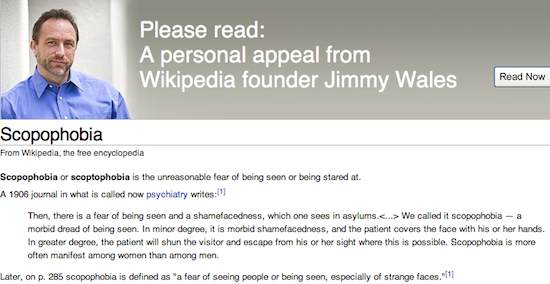
Jimmy Wales is a person who’s creation many depend on daily, but do not realize. For those who are not familiar, you may recognize him as this man in this banner. Wales is the founder of Wikipedia and has been prominently featured on his site for the past few months asking for donations. Wales also has a twitter account, which will be the subject of this post. Jimmy Wales’s account, appears to be a combination of personal tweets and tweets supporting his political beliefs in a ratio of about 1:1. For example, he has tweets about his delayed flight to Atlanta, but also has tweets concerning piracy, SOPA and PIPA, and the United States government. It can be assumed from his tweets that he is fairly liberal. Wales is one of the leaders against SOPA and it shows through a large fraction of his tweets against it, as well as the “With Your Help, We Can Defeat SOPA” statement in his “about me” section.
Wales’s twitter is interesting in that it is used for both for his personal life and business. Usually, business accounts, such as that of prominent scientist Richard Dawkins offer little original material, often linking to other sites. In comparison, personal accounts, such as that of Steven Colbert, offer original material, thoughts, and nonsensical tweets. Because Wales’s account does both, it is more personal that a business style account because it humanizes him, but also provides informative content. The personal nature of the account makes Jimmy more relatable, which could net him more flowers, helping to get his message out. In this sense, Wales’s twitter account is effective by attracting users to it.
However, the content of the posts seem to lack substance, although this is a fault of twitter’s character limitation more than that of the poster. I found the most informative posts to be those that link outward to other sites. Because the most interesting ideas are usually complex and nuanced, it can be difficult if not impossible to express them in 130 words or less. Although for entertainers such as Steven Colbert, 130 characters may be a perfect amount to deliver that punchline, it is not enough for complex arguments. In fact, the majority of his more serious posts, such as “5% think Congress doing a good job but re-election rates will remain high: evidence of a corrupt system?” are linked to full articles on other sites.
Wales attempts to bring up a number of political topics he finds important. The majority of them point to SOPA and the government’s unwavering support of it. He tweets updates on the results of his Wikipedia SOPA blackout, as well as commentary on American congressmen’s lack of support for their constituency. Although it is clear that Wales is against the current political system and against Internet censorship, it is not exactly evident why. Looking through his feed, he does not specifically mention why he is against the corrupt system or even why the system is corrupt. Again, I feel that this is not the fault of the author, but the nature of twitter. Attempting to convey these types of ideas would be confusing oversimplified and would not do the idea justice. Because of this, should serious discussion even be conducted on twitter? If this is the case, can any social media be used as a medium for serious discussion?
Subscribe to:
Comments (Atom)